Editions

Three editions, all available now.

Trim size: 7 by 10 inches. 401 pages (402 in the Barnes & Noble paperback). Publisher: Sykesystem Publishing. Published: October 1, 2026.

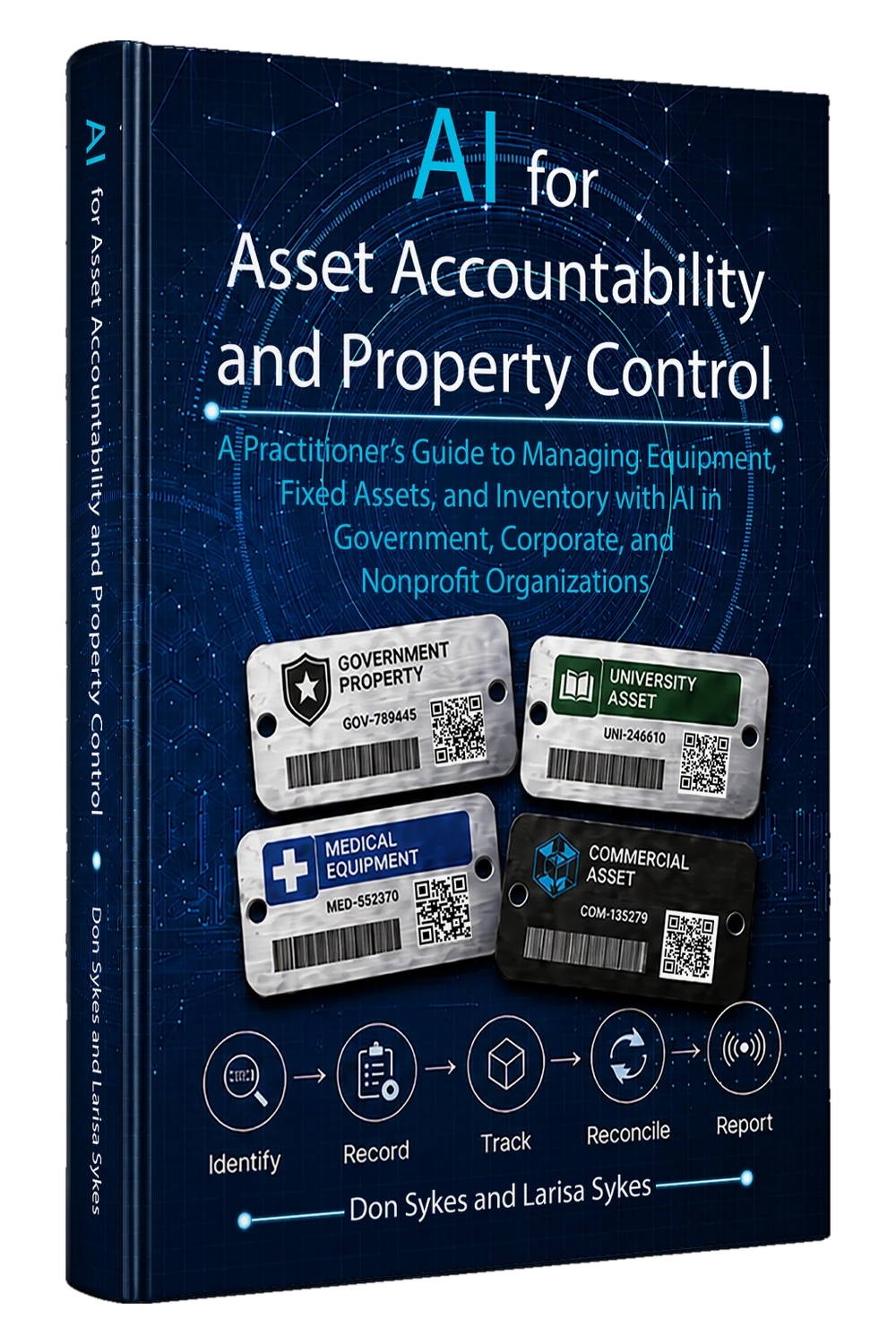
Asset accountability comes down to a record and the trust in that record. Cycle counts, receipts, transfers, dispositions, physical inventory, financial reconciliation: the daily work of keeping the numbers honest against a physical reality that keeps shifting. The people doing that work are now being asked to adopt AI, often by leaders who have not read a discrepancy report in a decade. This book is written for the people who carry the records. It maps how to bring AI into inventory, equipment, and fixed-asset workflows without breaking the audit trail, the chain of custody, or the confidence of the auditors and controllers who depend on the numbers. The examples come from real programs across federal, commercial, and nonprofit environments. The recommendations can be defended in a compliance review, because defending them in a compliance review is what the authors do.

The methodology in this book is also available as a delivered engagement through Sykesystem Advisory.

Who this book is for

Government property professionals

DoD, civilian agency, and federally-funded program property managers responsible for FAR- and DFARS-compliant accountability of government-furnished and contractor-acquired property. You are already required to produce evidence for auditors. AI can strengthen your position or expose you to new risks. This book shows you which is which.

Corporate asset managers

Fixed-asset accountants, facilities and equipment managers, and operations leaders responsible for balance-sheet accuracy, tax reporting, and physical inventory reconciliation. The book gives you methods that hold up under external audit and internal controls testing.

Nonprofit operations leaders

Grant-funded organizations and mission-driven operations where equipment and inventory accountability affects funder trust and program continuity. The book shows you how to adopt AI at a scale that fits your budget and your team.

What the book delivers

  • A framework for evaluating AI tools against actual accountability requirements.
  • Guidance on data hygiene, without which AI produces confident nonsense.
  • Workflows for the most common inventory and asset functions: receipt, transfer, physical inventory, disposition, and audit response.
  • A compliance lens on model selection, deployment, and record retention.
  • QR-linked companion resources: prompt libraries, policy templates, checklists, and reference materials for every reader of the book.

The companion collection

Every copy of AI for Asset Accountability and Property Control includes access to a growing set of downloadable companion resources, delivered through QR codes printed inside the book. The current collection:

  • The Complete Prompt Library All 103 workflow prompts from the book, parameterized with fill-in placeholders, grouped by lifecycle phase, sector, and source chapter.
  • Policy and SOP Templates Editable asset-accountability policy, receiving-and-tagging SOP, RACI matrix, and acceptable-use templates from the toolkit chapters.
  • Checklists Pack Print-or-fill inventory, reconciliation, exception, and audit-preparation checklists.
  • Audit-Readiness Scorecard A self-scoring worksheet to gauge audit and PMSA readiness before an examiner arrives.
  • Implementation Roadmaps The triage, owners, and cadence roadmaps for starting fresh, repairing an existing program, or scaling AI into one.
  • Regulatory Quick Reference One-page crosswalk of the 2024 Uniform Guidance thresholds, FAR Part 45, and DFARS 252.245-7005 the book relies on.
  • Glossary The book's glossary as a standalone quick-reference sheet.
  • Master Workflow Index The prompt index (Figure 63) and key workflow diagrams as a one-look reference.
  • Bonus Prompt Packs and Worked Examples More complex, chained, and sector-specific prompt sets. Added after launch and updated periodically.

The collection continues to grow after launch. Access is included with your copy of the book.

Table of contents

Twenty-five chapters in six parts, plus reference material.

Part I

Foundations

  1. 1What This Book Is (and Isn’t)3
  2. 2The Asset Accountability Lifecycle and Control Objectives15
  3. 3AI Essentials for Asset Professionals33
  4. 4The AI Tool Landscape51
  5. 5Secured AI: Government-Licensed and Enterprise Deployments59
  6. 6Policy Constraints and Local Authorization73
Part II

The Core System

  1. 7Building an Asset Accountability System91
  2. 8Master Data, Tagging, and Records Management105
  3. 9Periodic Inventories, Reconciliations, and Exceptions119
  4. 10Audit Readiness135
  5. 11Cross-Sector AI Workflows for the Core System151
Part III

Anchor Sectors

  1. 12GovCon: Government Property and FAR-Driven Controls171
  2. 13Corporate Fixed Assets and Inventory (SOX-Style)185
  3. 14IT Assets and Enterprise Asset Management (ITAM/EAM)201
Part IV

Additional Sector Playbooks

  1. 15Healthcare Equipment and Clinical Assets217
  2. 16Education: Student Devices, Lab Equipment, and Campus Assets231
  3. 17Nonprofit: Other People’s Money245
Part V

Risk, Policy, and the Human Element

  1. 18The AI Regulatory Landscape259
  2. 19AI Risk Management for Asset Professionals277
  3. 20Policy Patterns for AI-Assisted Asset Management291
  4. 21The Human in the Loop303
Part VI

Toolkits

  1. 22Policy and SOP Templates319
  2. 23Checklists337
  3. 24The Complete Prompt Library349
  4. 25Implementation Roadmaps359
  • Regulations Overview367
  • Glossary372
  • Cross-References and Resources381
  • Companion Library and Downloads383
  • About the Authors384

From Chapter 1

Every chapter opens with a scene from the work. This is how the book starts.

Chapter One

What This Book Is (and Isn’t): Asset Accountability, Not Real Estate

Kabul, 2010. Somewhere between the Czech Republic and my receiving line, an Mi-17 tail boom had gone missing, and for six weeks everyone above me wanted my records to say otherwise. The paperwork said shipped. The vendor said delivered. The US Government couldn’t pay the Czech company until the boom showed received, and the pressure to make that entry climbed the chain until it came back down wearing stars. It has to be there, they told me. It is too big to miss. I know it’s too big to miss, I said. That’s how I know we didn’t get it.

A tail boom is not a line item you take on faith. It’s a third of a helicopter. So I held the position that mattered: not received, not signed for, not in my records until it was on my ramp. The boom finally surfaced in a German customs lot, held up over a short payment, and flew into Kabul on the next IL-76. The Czech crew was apologetic in ways I had to decline. Twice.

Nothing in that six weeks required a database. What it required was a property manager willing to tell a general that the record says what is true, and the record was not going to say anything else. That’s the difference between responsibility and accountability, and it’s where this book begins. Accountability is a signature with consequences attached.

The tools in the chapters ahead can draft your documentation, reconcile your data, and organize your evidence. Not one of them can stand on the ramp and refuse to sign.

Don Sykes, CPPM

Every profession has a cocktail-party problem. Mention that you work in asset accountability or property control, and people either assume you sell houses or their eyes glaze over entirely. Neither reaction is helpful, but the first one is the reason this chapter exists.

Before we build a single workflow or write a single AI prompt, we need to establish exactly what this book covers, what it does not cover, and why the distinction matters.

Drawing the Line: What “Property” Means Here

In everyday language, “property” usually means land and buildings. In asset management, it means something broader and more specific at the same time. Property, in our context, refers to tangible items that an organization owns, leases, controls, or is custodially responsible for. That includes equipment, IT hardware, vehicles, tools, instruments, furniture, controlled inventory, capital assets, and sensitive items. It does not include the building those items sit in.

Chapter 1 continues for another eleven pages.
QR code that opens the Amazon review page for AI for Asset Accountability and Property Control

Read the book? Leave a review on Amazon.

Reviews help other practitioners judge whether the book fits their work. Scan the code, or use the link.

sykesystem.com/review/ai-asset-accountability

About the authors

Don Sykes has spent seventeen years leading programs and property functions across federal and international operations, most of it accountable for equipment and Government Property he could not always see. His portfolios have reached the Middle East, the Pacific, and polar research support. He holds the CPPM, PMP, CFM, and Six Sigma Black Belt certifications, along with a post-graduate certification in Artificial Intelligence and Machine Learning from Purdue University and Simplilearn.

About Don →

Larisa Sykes manages property the way an auditor reads a ledger. As a Senior Program Property Manager she has led international teams responsible for global asset records exceeding a billion dollars. Her recent work has centered on preparing contractor organizations for DCMA Property Management System Analyses.

About Larisa →